


Quick answer
A space heater’s electricity use equals its wattage divided by 1,000, multiplied by active heating hours. A generic 1,500 W heater uses 1.5 kWh per hour at full output. Multiply by your electricity rate for cost; thermostat cycling can reduce consumption, but insulation and weather affect the result.
Running cost calculator
Per day
CA$0.26
Per month (30 days)
CA$7.80
Estimated at ~CA$0.13/kWh. Actual rates vary by utility and time of use. A heater with a thermostat cycles off once the room is warm, so real use is often lower.
Key takeaways
- Cost = watts ÷ 1000 × hours × your rate per kWh.
- With a thermostat, the heater cycles on and off once the room is warm, so real-world use is usually lower than the full wattage.
- Heat one room, close the door, use eco mode and set the timer.
The formula
Cost = watts ÷ 1000 × hours × your rate per kWh. A 500 W heater running 4 hours uses 2 kWh.
Why the thermostat matters
With a thermostat, the heater cycles on and off once the room is warm, so real-world use is usually lower than the full wattage.
Choose your bundle
Free shipping
Prices in CAD. Most homes need one per room.
Your order
- 2 RapidHeat heatersCA$119.00
- Tracked shipping across CanadaFREE
- 30-day guaranteeIncluded
TotalCA$119.00
You save CA$200
Ships with tracking. Free across Canada. You won't be charged until you review your order.
- Free Canada shipping
- 30-day returns
- Secure checkout
Ways to use less
Heat one room, close the door, use eco mode and set the timer.
Start with watts, hours and kilowatt-hours
A space heater uses electricity according to its actual power draw and the time its heating element operates. Watts measure how quickly it uses energy; kilowatt-hours measure the accumulated amount you buy. Hydro-Québec explains that a 1,000-watt appliance running for one hour uses one kilowatt-hour. Reading these two units correctly makes it easier to compare appliances without relying on advertising language or guessing from the size of the case.
Find the input rating on the heater label or in its manual. Do not infer it from a standard 120V plug, the word ceramic, or a room-size claim. For generic examples, a 500 W heater uses 0.5 kWh per active hour, a 750 W heater uses 0.75 kWh, and a 1,500 W heater uses 1.5 kWh. A smaller draw also means less heat delivered per hour, so it is not automatically enough for your room.
| Province | Approx. CA$/kWh | Example heater | 1 hour | Day: 4 hours | Month: 30 days |
|---|---|---|---|---|---|
| British Columbia | 0.12 | 500 W | 0.060 | 0.24 | 7.20 |
| British Columbia | 0.12 | 750 W | 0.090 | 0.36 | 10.80 |
| British Columbia | 0.12 | 1,500 W | 0.180 | 0.72 | 21.60 |
| Alberta | 0.20 | 500 W | 0.100 | 0.40 | 12.00 |
| Alberta | 0.20 | 750 W | 0.150 | 0.60 | 18.00 |
| Alberta | 0.20 | 1,500 W | 0.300 | 1.20 | 36.00 |
| Saskatchewan | 0.19 | 500 W | 0.095 | 0.38 | 11.40 |
| Saskatchewan | 0.19 | 750 W | 0.143 | 0.57 | 17.10 |
| Saskatchewan | 0.19 | 1,500 W | 0.285 | 1.14 | 34.20 |
| Manitoba | 0.11 | 500 W | 0.055 | 0.22 | 6.60 |
| Manitoba | 0.11 | 750 W | 0.083 | 0.33 | 9.90 |
| Manitoba | 0.11 | 1,500 W | 0.165 | 0.66 | 19.80 |
| Ontario | 0.13 | 500 W | 0.065 | 0.26 | 7.80 |
| Ontario | 0.13 | 750 W | 0.098 | 0.39 | 11.70 |
| Ontario | 0.13 | 1,500 W | 0.195 | 0.78 | 23.40 |
| Québec | 0.08 | 500 W | 0.040 | 0.16 | 4.80 |
| Québec | 0.08 | 750 W | 0.060 | 0.24 | 7.20 |
| Québec | 0.08 | 1,500 W | 0.120 | 0.48 | 14.40 |
| New Brunswick | 0.15 | 500 W | 0.075 | 0.30 | 9.00 |
| New Brunswick | 0.15 | 750 W | 0.112 | 0.45 | 13.50 |
| New Brunswick | 0.15 | 1,500 W | 0.225 | 0.90 | 27.00 |
| Nova Scotia | 0.19 | 500 W | 0.095 | 0.38 | 11.40 |
| Nova Scotia | 0.19 | 750 W | 0.143 | 0.57 | 17.10 |
| Nova Scotia | 0.19 | 1,500 W | 0.285 | 1.14 | 34.20 |
| Prince Edward Island | 0.18 | 500 W | 0.090 | 0.36 | 10.80 |
| Prince Edward Island | 0.18 | 750 W | 0.135 | 0.54 | 16.20 |
| Prince Edward Island | 0.18 | 1,500 W | 0.270 | 1.08 | 32.40 |
| Newfoundland and Labrador | 0.14 | 500 W | 0.070 | 0.28 | 8.40 |
| Newfoundland and Labrador | 0.14 | 750 W | 0.105 | 0.42 | 12.60 |
| Newfoundland and Labrador | 0.14 | 1,500 W | 0.210 | 0.84 | 25.20 |
Compare running cost, not efficiency slogans
Use this calculation: watts divided by 1,000, multiplied by hours of active heating, multiplied by your electricity price per kilowatt-hour. As a generic example, a 1,500 W heater operating continuously for four hours uses 6 kWh. At an illustrative CA$0.15 per kWh, that costs CA$0.90. Thirty identical days would cost CA$27. These numbers describe an example heater, not RapidHeat. Replace the example rate with the variable charges on your own bill; a fixed monthly account fee normally stays unchanged.
All electric resistance heaters turn essentially all the electricity they consume into heat in the room. Ceramic elements and oil reservoirs do not change that basic relationship. A thermostat can reduce operating time once the space is warm, while a lower power setting reduces heat output as well as draw. Savings depend on avoiding unnecessary heat, not creating more heat from each purchased kilowatt-hour. Compare a full week of household energy use, allowing for weather and occupancy, before deciding whether a new routine actually saves money.
Read the approximate provincial cost table
The provincial table uses approximate 2026 budgeting assumptions in Canadian dollars per kilowatt-hour, not verified current utility tariffs. Within each province, providers, tiers, time-of-use periods, delivery charges and taxes can change what additional electricity actually costs. These figures are meant to show the calculation clearly. They should not be presented as a quote from your utility or used to decide between electricity contracts without checking the current terms.
Each daily amount assumes four hours of continuous heating; each monthly amount assumes thirty such days, or 120 active hours. The hourly figure assumes one full hour at the named wattage. No thermostat reduction is built in. Rows are rounded only after calculating, so multiplying a displayed rounded hourly price may give a slightly different result. Territories are not included because this comparison uses the ten provincial assumptions supplied for the guide.
Distinguish elapsed time from heating time
A heater switched on for four hours may not heat continuously for four hours. Once the thermostat senses its target temperature, the element can cycle off and back on. A generic 1,500 W heater heating for half of a four-hour session would use about 3 kWh for the element, rather than 6 kWh. A fan or electronic controls may use a small additional amount; use measured consumption if you need a closer estimate.
Do not assume a particular duty cycle in advance. On a mild afternoon in an insulated office, the element may pause often. Beside a draughty window on a very cold evening, it may run almost continuously. A heater that is too small for the heat loss might never reach the setting. For a prudent first budget, calculate the continuous-use cost and then compare it with actual household meter readings.
Find the right electricity price on your bill
Look for charges that rise when you use another kilowatt-hour, rather than dividing the entire bill by consumption without thinking about fixed fees. Energy charges may be only part of the incremental price. Some delivery components, adjustments and taxes also vary with use, while basic account charges do not. Your utility can explain which components belong in an estimate of the extra cost of operating one appliance.
With time-of-use pricing, calculate each period separately. For example, two hours at a lower price and two hours at a higher price are not the same as four hours at the lowest advertised rate. Tiered plans can also put extra heating into a more expensive block. Take account of your actual tariff and usage pattern before deciding whether an evening session is inexpensive or whether a different thermostat schedule would help.
What eco mode and a thermostat can change
Eco is a control label, not a universal technical standard. Depending on the model, it can adjust output, change the temperature target or cycle heating differently. Read the manual rather than assuming eco mode always cuts consumption by a fixed percentage. A digital display does not prove that the temperature is uniform throughout a room; the sensor near the heater may read warmer than your chair across the room.
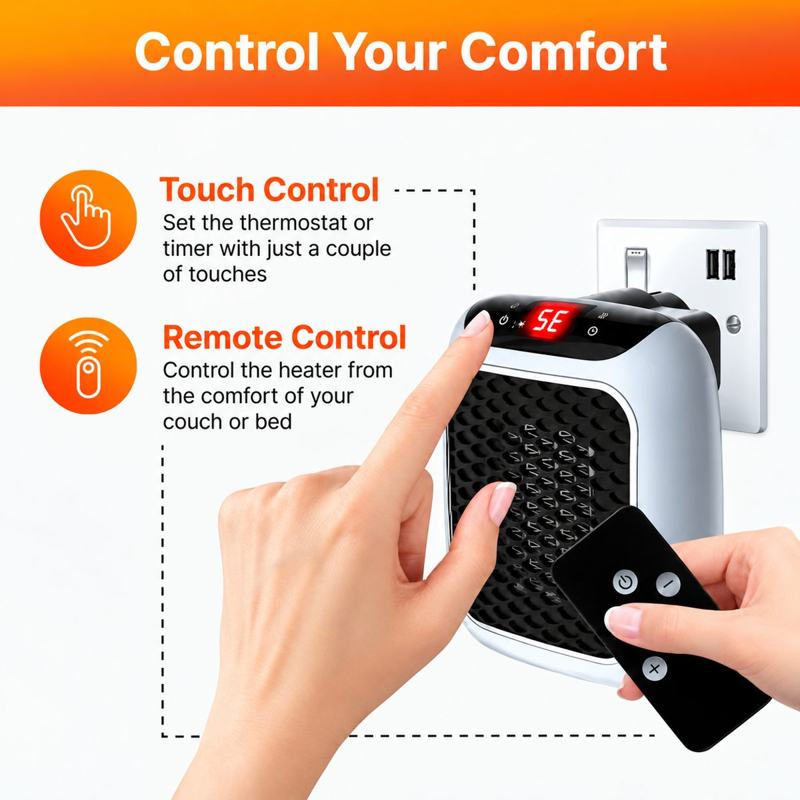
RapidHeat is a plug-in ceramic PTC heater with high and eco modes, a digital thermostat, remote, timer and overheat protection for small-to-medium rooms. Its wattage is not established here, so none of the numerical examples is a RapidHeat consumption claim. Check the actual product label and instructions before estimating its cost or comparing its output with another heater. The useful question is how much energy is needed for your particular comfort goal.
When zone heating can lower the total bill
An added heater does not automatically replace heat from the main system. If you keep the furnace or baseboards at the same settings, the portable unit usually adds consumption. Savings are possible when you lower heating elsewhere safely and use a modest amount of supplemental heat in one occupied room. Ontario’s Save on Energy makes this distinction explicitly: running both systems as usual is not a saving strategy.
The economics depend on what you displace. Electric resistance heat may cost more per unit of delivered warmth than a well-performing heat pump or, in some places, gas heating. Keep sufficient whole-home heat for people, plumbing and moisture control. Do not shut supply vents indiscriminately in a forced-air system. Try a small, reversible change and compare both electricity and fuel bills rather than celebrating a reduction in just one of them.
Reduce the room’s heat demand before adding hours
Seal accessible draughts around windows and doors where appropriate, without blocking intentional ventilation. Close a room door if doing so is compatible with the home’s heating and ventilation layout. Use window coverings after dark while maintaining heater clearances. Move a desk away from a cold pane or exterior wall if possible. These changes can improve comfort without requiring the element to operate for another hour every day.
Use the lowest comfortable temperature and only heat the occupied space while you are awake and present. A higher thermostat setting generally does not make a fixed-output resistance heater produce heat faster; it mainly asks it to run longer. If the room remains cold after basic draught fixes, investigate insulation, heat distribution and equipment capacity. More runtime is not always the cheapest or safest response to a room that loses heat rapidly.
Make safe placement part of the decision
Health Canada advises checking for a Canadian certification mark before buying an electrical product. Inspect the actual label and read the instructions; a retailer description is not a substitute. Plug a portable heater directly into a sound wall outlet, never a power bar or extension cord. Keep at least one metre from things that can burn, and follow any greater clearance in the manual. For floor models, use a firm, level surface. For direct wall-plug models, follow the specified outlet position and mounting instructions instead.
Turn the heater off and unplug it before leaving the room or going to sleep, as the NFPA recommends. A thermostat, timer or overheat cut-off is a useful safeguard, not permission for unattended use. Stop using a heater if the plug, outlet or casing shows damage, scorching or unusual heat. Have a qualified electrician investigate the outlet rather than trying a different adapter. Keep children, pets, water and drying laundry away, and never block an exit with equipment or furniture.
Sources
Frequently asked questions
How much does a 500 W heater cost per hour?
At an illustrative CA$0.15/kWh, a generic 500 W heater costs CA$0.075 per full-output hour. That is 7.5 cents, before any additional variable charges or taxes not included in that example rate.
Does a heater use power when its thermostat switches off?
The heating element stops drawing its full heating power, but controls or a fan may still consume electricity. Consult the manual for the operating behaviour of a particular model.
Are the provincial prices official 2026 tariffs?
No. They are approximate planning assumptions, not live tariff quotations. Use your own utility’s applicable variable charges for a personal estimate, particularly with tiered or time-of-use billing.
Does a lower wattage always mean a lower monthly bill?
Only if operating time and other conditions are comparable. A smaller heater may run longer or fail to keep up with heat loss. Calculate energy over the whole session, not just the instantaneous draw.
Can I run a heater all night to use cheaper electricity?
Do not leave a portable heater operating while asleep. NFPA and BC Hydro advise turning it off before bed. Use a suitable installed heating system for overnight warmth.
Can these examples tell me RapidHeat’s running cost?
No. The examples are generic and are not tied to RapidHeat. Obtain the product’s input rating and operating instructions, then substitute that information and your electricity price into the formula.
Is it cheaper to run a space heater than central heat?
Often, yes, if you turn the central thermostat down and heat only the room you're using. Results depend on your fuel prices and home.
Related
Choose your bundle
Free shipping
Prices in CAD. Most homes need one per room.
Your order
- 2 RapidHeat heatersCA$119.00
- Tracked shipping across CanadaFREE
- 30-day guaranteeIncluded
TotalCA$119.00
You save CA$200
Ships with tracking. Free across Canada. You won't be charged until you review your order.
- Free Canada shipping
- 30-day returns
- Secure checkout
- 30-day guarantee
- Free shipping in Canada
- Secure checkout