


Quick answer
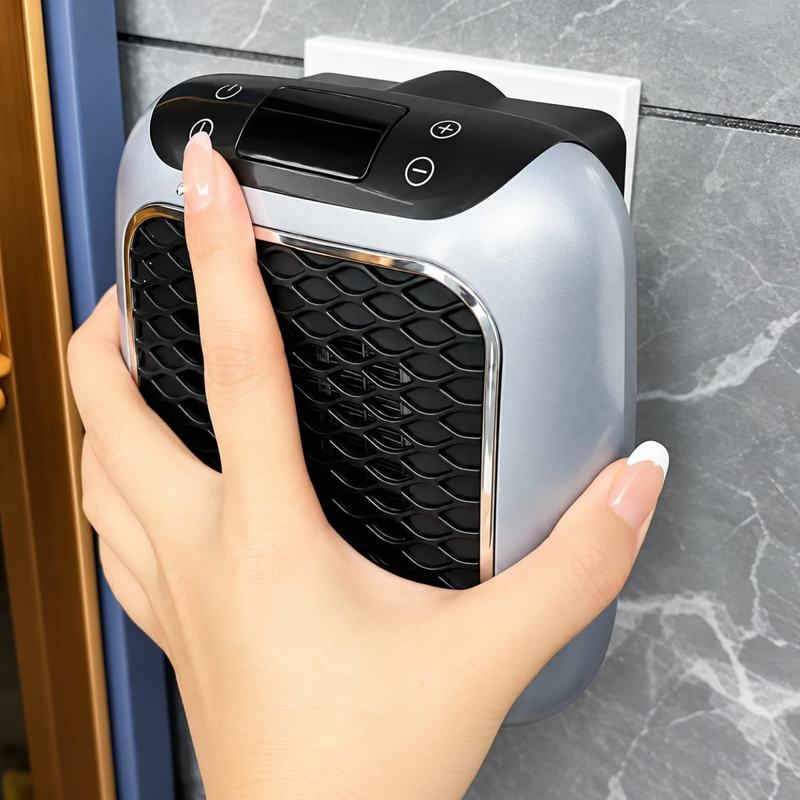
A plug-in heater should be chosen around the wall outlet as carefully as the room. RapidHeat connects directly to a standard 120V Canadian outlet without a cord and provides ceramic fan heat for small-to-medium rooms. Check clearances, outlet condition and building rules; direct-plug convenience does not remove normal heater safety precautions.
Why choose a plug-in heater
Wall-plug heaters free up floor space and keep cords out of the way, which is useful in bathrooms, hallways and small bedrooms.
- Plugs straight into a standard outlet
- Takes up almost no space
- Remote control from across the room
Safety tip
Plug heaters directly into the wall. Avoid extension cords and power bars, which can overheat.
Choose your bundle
Free shipping
Prices in CAD. Most homes need one per room.
Your order
- 2 RapidHeat heatersCA$119.00
- Tracked shipping across CanadaFREE
- 30-day guaranteeIncluded
TotalCA$119.00
You save CA$200
Ships with tracking. Free across Canada. You won't be charged until you review your order.
- Free Canada shipping
- 30-day returns
- Secure checkout
Understand what wall-plug heating does not mean
A direct-plug heater and a permanently installed wall heater are different purchases. RapidHeat is a portable appliance supported at its outlet, not a hardwired room-heating installation. Do not assume it offers the coverage, installation options or continuous-duty role of a professionally selected fixed heating system simply because both sit near a wall.
This distinction matters when comparing search results for plug-in wall heaters. Some shoppers want occasional warmth in an occupied office; others need a permanent solution for an unheated addition. Describe the task first. If it involves an entire floor, a building-code requirement or reliable unattended heating, seek a properly planned alternative.
| Situation | What to check | Practical decision |
|---|---|---|
| Direct-plug appliance | Outlet position and support | Choose only where clearances can be maintained. |
| Corded portable heater | Floor position and direct wall connection | Assess a different footprint and cord route. |
| Hardwired wall heater | Professional sizing and installation | Consider for a permanent heating need. |
| Central heating | Whole-building heat demand | Use for the broader home-heating job. |
Audit the actual outlet before ordering
Look at the outlet you would really use, rather than the nearest one on a floor plan. Is it secure, accessible and clear of furniture? Is there a curtain above it or a pile of magazines beside it? A direct-plug design cannot be repositioned a little farther away using its power cord because there is no cord.
Do not use an outlet with visible damage, discolouration or a loose connection. If the heater does not sit securely as instructed, stop and ask for qualified electrical advice. Avoid improvised brackets or supports. An older rental may need outlet maintenance before any new appliance is appropriate, even if other small devices still work there.
Consider circuit demand, not just socket availability
Different wall outlets can share a circuit. Plugging appliances into different locations does not necessarily separate their electrical demand. Kitchens, workspaces and older homes may already have several loads in use, so the number of unused sockets is not a dependable guide to how much extra heating a circuit can support.
RapidHeat's verified wattage is not provided here, which prevents a specific load calculation. Consult the product's electrical label and instructions, and ask an electrician if circuit capacity is uncertain. If a breaker trips, do not repeatedly reset it and try again, or move the heater around until something appears to work. Find the cause first.
Plan airflow around furniture and people
A useful outlet should allow the heater to discharge air without obstruction. A location behind a sofa or inside a bookcase defeats that purpose and can create unsafe proximity to materials. Keep the heater out of routes where it might be bumped, and remember that visitors may not expect an appliance projecting from the wall.
In a condo office, the clearest outlet may be on the opposite side from your desk. That is a room-layout issue, not a reason to place the heater against papers or a fabric chair. Evaluate comfort at your seat after establishing safe positioning; do not move combustible objects into the clearance zone to make the warmth feel stronger.
Follow a repeatable direct-plug safety routine
Use the heater only according to its instructions, with unobstructed airflow and a secure wall connection. Keep children and pets away. NFPA recommends a one-metre separation from things that can burn and switching portable heaters off when leaving the room or going to bed. A remote and timer do not change those precautions. [1](https://www.nfpa.org/-/media/project/storefront/catalog/files/safety-tip-sheets/heatingsafetytips.pdf)
Do not introduce an extension cord, power bar or multi-outlet adapter to solve a placement problem. Stop using the heater if the outlet becomes unusually hot, smells burnt or shows damage. Overheat protection is a product feature, not a guarantee that every connection or room layout is safe; electrical concerns need proper assessment.
Keep damp areas and unusual power supplies out of assumptions
A bathroom outlet does not establish that a heater is suitable for use beside water. No wet-location approval is provided here. Unless the product instructions specifically allow the intended environment and its requirements can be met, choose another way to warm that space. The same caution applies to damp basements or utility areas prone to splashes.
A garage, RV or off-grid cabin also introduces questions beyond plug shape. Supply capacity, temperature conditions and the intended environment all matter. Do not assume an adapter or inverter makes a household heater suitable. Ask for documented compatibility and appropriate electrical guidance rather than using a direct-plug format as evidence of universal portability.
Compare convenience with total buying cost
RapidHeat offers a remote, digital thermostat, high and eco modes, timer and overheat protection. Those are useful items to compare when the outlet and room are suitable. They do not establish heating area, electricity consumption or silent operation. Ask for missing technical information before relying on any of those points in a buying decision.
Prices are CA$79 for one, CA$119 for two, CA$159 for three and CA$239 for four; shipping is free in Canada and returns are available for 30 days. Count suitable locations before choosing a bundle. Buying several wall-plug heaters is not a substitute for assessing whether the electrical supply can support their intended use.
Test the placement, not only the controls
During your evaluation, use an ordinary occupied session and keep the main heat at its usual setting. Observe whether the room becomes comfortable where you sit and whether normal activities keep the heater area clear. A location that works only after moving half the room may not be practical through a Canadian winter.
Keep packaging and order records while deciding. Check that the controls and remote suit your needs without inventing a remote range or temperature accuracy. If the outlet position makes RapidHeat awkward or unsafe, a different heater format may be a better choice. The right result is a workable heating arrangement, not keeping an unsuitable appliance.
RapidHeat: honest pros and cons
Good for
- No trailing cord across the floor.
- Connects to a standard 120V Canadian outlet.
- Remote allows convenient adjustments in a suitable room.
- Thermostat and timer support attended use.
- No hardwiring is part of its direct-plug format.
Not ideal if
- Cannot be moved away from an outlet with a cord.
- Outlet condition and available circuit capacity matter.
- Not a permanent whole-home heating installation.
- No wet-location suitability is established.
Sources
Frequently asked questions
Is a plug-in wall heater the same as a hardwired heater?
No. RapidHeat plugs into an outlet and is not a fixed electrical installation. If you need permanent room heating, ask a qualified professional about appropriate sizing, installation and local requirements rather than comparing solely by wall placement.
Can a wall-plug heater go behind a couch?
Do not place it where furniture obstructs airflow or violates the required clearance. A hidden outlet may be unsuitable even though it is electrically accessible. Choose a clear location or a different heating arrangement.
Can I use a smart plug to control it?
Do not assume compatibility with an external switching device. Follow the product instructions and confirm any proposed control arrangement before use. The included timer is not permission to operate the heater while away or asleep.
Why does the wall outlet get hot with a heater?
Unusual heat can indicate a connection or loading problem. Stop using the heater and have the outlet assessed by a qualified electrician. Do not diagnose a potentially unsafe connection by repeatedly plugging it back in.
Can I put two plug-in heaters on different outlets?
Different outlets may share the same circuit. Confirm each heater rating and the circuit capacity before considering simultaneous operation. Without that information, it is not possible to say that two outlets make the arrangement suitable.
Is a higher wall outlet better for heating?
Not necessarily. Safe support, required clearances and airflow matter more than a general height rule. Follow the product instructions and do not improvise orientation, adapters or mounts to change how the appliance sits.
Can I use a plug-in heater with an extension cord?
No. Heaters draw a lot of current, so always plug them directly into a wall outlet.
How much does RapidHeat cost in Canada?
RapidHeat is CA$79 for one, CA$119 for two, CA$159 for three and CA$239 for four, with free shipping across Canada.
Can I return it?
Yes. Contact us within 30 days of delivery to start a return.
Related
Choose your bundle
Free shipping
Prices in CAD. Most homes need one per room.
Your order
- 2 RapidHeat heatersCA$119.00
- Tracked shipping across CanadaFREE
- 30-day guaranteeIncluded
TotalCA$119.00
You save CA$200
Ships with tracking. Free across Canada. You won't be charged until you review your order.
- Free Canada shipping
- 30-day returns
- Secure checkout
- 30-day guarantee
- Free shipping in Canada
- Secure checkout