


Quick answer
Use a portable heater only while awake and present, with at least one metre from combustible materials and any greater clearance the manual requires. Plug directly into a sound wall outlet, keep it dry and uncovered, and switch it off and unplug before leaving or sleeping. Check its Canadian certification mark before buying.
Key takeaways
- Follow these every time.
The 10 rules
Follow these every time:
- Keep 1 metre of clear space around it
- Plug directly into a wall outlet
- Never use an extension cord or power bar
- Turn it off when you leave the room
- Use the timer at night
- Keep it away from water
- Never cover it or dry clothes on it
- Keep kids and pets supervised
- Choose overheat protection
- Test your smoke alarms
Choose your bundle
Free shipping
Prices in CAD. Most homes need one per room.
Your order
- 2 RapidHeat heatersCA$119.00
- Tracked shipping across CanadaFREE
- 30-day guaranteeIncluded
TotalCA$119.00
You save CA$200
Ships with tracking. Free across Canada. You won't be charged until you review your order.
- Free Canada shipping
- 30-day returns
- Secure checkout
Rule 1: read the manual and inspect the label
Before first use, read the instructions for the exact model, including its intended environment, placement and shutdown procedure. Health Canada advises looking for a Canadian certification mark on electrical products before purchase. A brand name, a seller’s safety wording or a familiar plug shape is not a substitute for that mark. Check the physical unit and packaging, and contact the seller if essential label information or instructions are missing.
Keep the manual where household members can find it. Note whether the appliance is floor-standing, wall-mounted or designed to plug directly into a receptacle; these designs have different positioning requirements. Check the product’s actual electrical input rather than guessing from its size. If you buy a used heater, damaged parts, missing labels or an uncertain history are reasons to pause and seek reliable information instead of experimenting.
| Check | Proceed only when |
|---|---|
| Product | Label and instructions are available; certification mark checked |
| Placement | Required clearances and correct support are possible |
| Connection | Direct wall outlet is sound and secure |
| Environment | Dry, uncluttered and appropriate under the manual |
| Supervision | An awake adult can remain present |
| Shutdown | Switch-off and unplugging happen before sleep or departure |
Rules 2 and 3: maintain clearance and stable placement
The NFPA advises at least one metre between a portable heater and anything that can burn, including people. Follow any greater distance in the manufacturer’s instructions. Check curtains, bedding, upholstery, paper, clothing and shelves above or beside the unit. Look beyond its immediate footprint: a curtain can move in a draught and a blanket can slide from a chair after you have decided the location is clear.
Floor-standing heaters belong on a solid, level surface, not a bed, sofa or furniture perch. Keep them out of foot traffic and away from exits. A direct wall-plug model must use an outlet and orientation permitted by its manual, with the required clearance around it; do not improvise a floor setup. Never relocate a hot heater by a cord or grille. Switch it off and let it cool as directed before moving it.
Rule 4: connect directly to a sound wall outlet
Plug a portable heater directly into a wall outlet, not an extension cord, power bar or multi-outlet adapter. These extra connections can overheat or be unsuitable for the sustained load. A plug should sit securely without wobbling or sagging. Do not force a damaged plug into place or use an improvised support that blocks airflow. If a direct wall-plug heater cannot fit the receptacle as instructed, that location is not suitable.
Outlet position does not tell you which circuit supplies it. Two receptacles on opposite walls may share a breaker with lights and other equipment. If a breaker trips or you need several high-load appliances in the area, have a qualified electrician assess the load and wiring. Never fit a larger breaker to stop nuisance trips or repeatedly reset one without resolving the cause. Avoid simultaneous heavy loads on a circuit unless capacity has been confirmed.
Rule 5: stay awake and present
Turn the heater off and unplug it when you leave the room or go to bed, as the NFPA recommends. BC Hydro also advises against unattended or sleeping use. A timer is helpful for ending a session but does not supervise the appliance. Being elsewhere in the home or having a camera pointed at it is not equivalent to being present and able to respond promptly to a problem.
Build shutdown into transitions: finishing work, leaving for errands and starting the bedtime routine. Check the actual heater rather than relying on memory of a remote-control button press. Keep the plug accessible, but do not create a trip hazard to do so. If a household member cannot safely monitor or disconnect the unit, arrange another appropriate source of warmth rather than treating a portable heater as essential unattended equipment.
Rule 6: keep water away and do not assume bathroom suitability
A standard outlet and a compact case do not establish that a heater is approved for bathroom use. Follow the manufacturer’s stated environment restrictions. Water, wet hands, splashes and damp floors create additional shock risks. Do not put a heater beside a bath, basin or shower, and do not reach for an electrical appliance that has fallen into water. Keep portable heaters away from outdoor precipitation and damp utility areas unless expressly designed for those conditions.
A GFCI is an important electrical safeguard where required, but it does not turn an unsuitable heater into a bathroom-rated product or remove clearance requirements. Avoid using a heater where towels can fall onto it or where spray can reach the outlet. If you need regular bathroom heating, ask a qualified professional about a correctly specified installed solution. Do not infer moisture suitability for RapidHeat or any other model without explicit documentation.
Rules 7 and 8: never cover it, and supervise access
Never dry socks, gloves or towels on a heater, cover its grille or drape clothing above its outlet. Blocking airflow can raise internal temperatures, and nearby fabric may ignite even when it does not touch the element. Keep storage boxes and dust away from intakes and outlets. Clean only as instructed, after switching off, unplugging and allowing the unit to cool; do not poke objects through a grille.
Keep children and pets away from hot surfaces and moving air outlets. Overheat protection does not prevent every contact burn. Consider a person’s mobility and ability to sense temperature before placing a heater nearby, and never aim it closely at someone who cannot move away. Keep play areas, pet beds and feeding bowls elsewhere. If safe separation cannot be maintained, choose a different heating approach instead of relying on repeated reminders.
Rule 9: understand protective controls
A thermostat regulates temperature; overheat protection responds to excessive internal heat; a tip-over switch, where fitted, responds to a fall. These functions address different situations. Check the model’s documented features rather than assuming every heater has all of them. Repeated automatic shut-offs are a reason to stop and investigate airflow, placement or faults, not a sign that the heater is safe to operate under poor conditions.
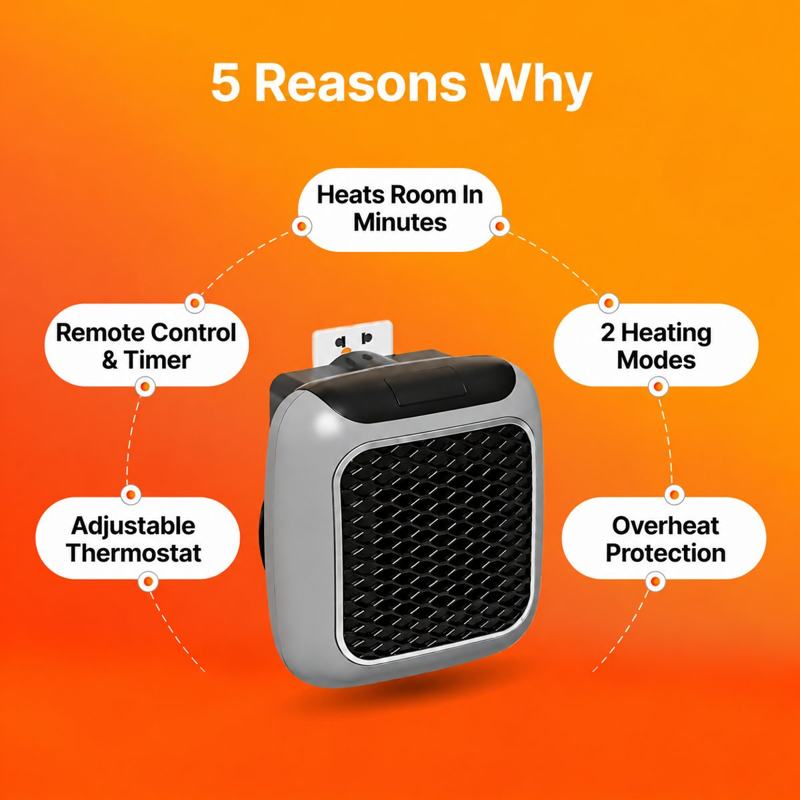
RapidHeat has a digital thermostat, timer, remote, high and eco modes and overheat protection in a plug-in ceramic PTC design for small-to-medium rooms. No wattage or certification is established here, and tip-over protection should not be assumed. Check its label and manual before purchase and use. Convenient controls can make supervised use easier, but they do not remove the need for direct connection, clearances, dry conditions and shutdown before sleep.
Rule 10: maintain alarms and an escape plan
Keep working smoke alarms in the locations required by your local rules and test them according to their instructions. Replace batteries or the alarm itself as required by the manufacturer. If your home has fuel-burning equipment, follow local carbon monoxide alarm requirements too. An electric resistance heater does not normally produce carbon monoxide, but other appliances or unsafe emergency heating choices may; never bring a barbecue or fuel-burning generator indoors.
Keep exits clear, agree on a household meeting place and make sure everyone knows to get out and stay out during a fire. Call 911 from a safe location. Do not use water on an electrical fire or delay leaving to disconnect equipment. Alarms and escape planning are essential backup measures, not permission to reduce clearance or leave a heater operating unattended. Safe daily habits should prevent the emergency rather than depend on detecting it.
Stop-use signs and a seasonal check
Before each heating season, inspect the case, plug, cord where present and accessible outlet face for damage. Stop if you see cracks, exposed conductors, scorch marks, a loose receptacle or evidence of melting. During operation, an unusual burning smell, sparking or abnormal heat at the connection also calls for immediate shutdown if it can be done safely. Have a qualified electrician assess outlet problems before using that location again.
Do not open a heater or bypass a protection device to keep it working. Check official recall information when there is a product concern and contact the manufacturer for appropriate service or replacement guidance. Store a clean, cool heater somewhere dry, with its cord protected if fitted. A brief inspection and a deliberate shutdown routine are simpler than responding to a fault after months of assuming an appliance is still in good condition.
Sources
Frequently asked questions
Can I use a heavy-duty extension cord?
Portable-heater guidance from the NFPA and BC Hydro is to connect directly to the wall. Do not solve a poor outlet location with an extension cord or power bar.
Is one metre of clearance always enough?
It is a general minimum in NFPA guidance. Follow any greater clearance or more specific directional requirement in the heater’s instructions, and consider objects that could move into that space.
Does a wall-plug heater need open space?
Yes. A compact wall-plug design still needs unobstructed airflow and separation from combustible materials. A socket hidden behind a sofa or curtain may be unsuitable.
Can a bathroom GFCI make any heater suitable?
No. It is not a substitute for manufacturer approval for the environment, safe separation from water or compliant placement. Do not assume bathroom suitability from the plug type.
What should I do if the breaker trips?
Stop using the heater on that circuit and investigate the cause with qualified help. Never repeatedly reset the breaker or replace it with a larger one to accommodate the appliance.
Do safety controls mean I can leave the room?
No. Thermostats and protective shut-offs are backup features, not supervision. Turn the heater off and unplug it before leaving the room or going to sleep.
Can a space heater cause a fire?
Any heater can if it's misused. Most heater fires start when something flammable is too close, so keep the clearance.
Related
Choose your bundle
Free shipping
Prices in CAD. Most homes need one per room.
Your order
- 2 RapidHeat heatersCA$119.00
- Tracked shipping across CanadaFREE
- 30-day guaranteeIncluded
TotalCA$119.00
You save CA$200
Ships with tracking. Free across Canada. You won't be charged until you review your order.
- Free Canada shipping
- 30-day returns
- Secure checkout
- 30-day guarantee
- Free shipping in Canada
- Secure checkout