


Quick answer
Choose a ceramic fan heater for quick, directed warmth during short, supervised sessions. Choose an oil-filled radiator when you prefer slower, steadier heat without fan noise. At equal electrical input and running time, both deliver broadly the same heat. Thermostat behaviour, room heat loss and operating hours determine practical costs.
Key takeaways
- Ceramic fan heaters suit quick, attended warm-ups.
Start with how you use the room
Ceramic fan heaters suit quick, attended warm-ups. Oil-filled radiators offer slower, quieter warmth. Neither technology makes heat free or removes portable-heater safety requirements.
Choose your bundle
Free shipping
Prices in CAD. Most homes need one per room.
Your order
- 2 RapidHeat heatersCA$119.00
- Tracked shipping across CanadaFREE
- 30-day guaranteeIncluded
TotalCA$119.00
You save CA$200
Ships with tracking. Free across Canada. You won't be charged until you review your order.
- Free Canada shipping
- 30-day returns
- Secure checkout
How the two technologies produce warmth
An oil-filled electric radiator contains a sealed heat-transfer fluid. An electrical element warms that fluid, which transfers heat to the metal body and then to the room through convection and radiation. The fluid is not burned as fuel, and normal use does not involve topping it up. The body stores some warmth, so the appliance can remain hot after its element switches off. That stored energy came from electricity used earlier, not from a separate source of free heat.
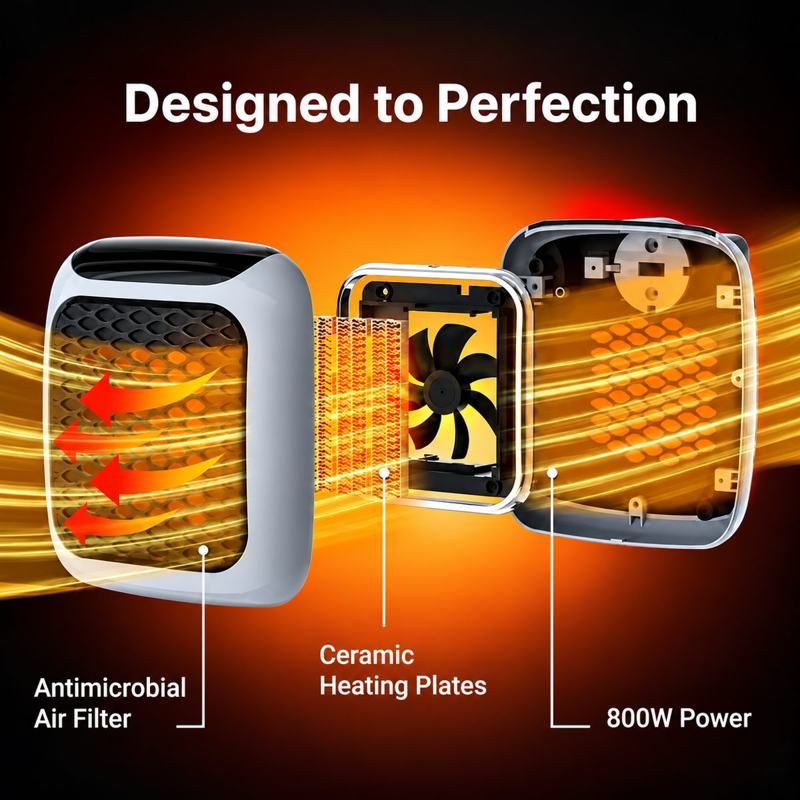
A typical ceramic fan heater uses an electrically heated ceramic element and a fan to move air across it. PTC ceramic material increases its electrical resistance as it heats, helping limit the element's temperature. That characteristic does not make the entire appliance cool to touch or immune to faults. Compare complete products, including their controls, instructions and protective features, rather than treating the element material as a complete safety or performance specification.
| Consideration | Oil-filled radiator | Ceramic fan heater |
|---|---|---|
| Initial warmth | Slower fluid and casing warm-up | Usually quick warm airflow |
| Noise | Usually no fan; possible clicks | Fan noise varies by model |
| After switching off | Stored heat releases gradually | Warm airflow generally ends quickly |
| Energy at equal input and heating time | Broadly the same | Broadly the same |
| Portable-use supervision | Required | Required |
Warm-up speed and the kind of comfort you feel
A ceramic fan heater usually delivers noticeable warm airflow soon after switching on. That can be useful when you sit down for a short work session or return to a chilly room. The area in the airflow may feel comfortable before the walls, furniture and air elsewhere have warmed. Avoid judging whole-room performance only from the warm stream near the outlet, and never position the appliance too close to your body to force a faster result.
An oil-filled radiator takes longer to warm its fluid and casing. Once hot, it releases warmth more gradually and continues doing so briefly after the thermostat stops the element. Some people prefer that less abrupt sensation during longer attended periods. A cold room still needs enough total heat input to replace its losses. Neither a quick fan nor a warm radiator body guarantees that a draughty room will reach your desired temperature.
Running costs: compare energy, not heater labels
Both technologies are electric resistance heating, converting nearly all consumed electricity into heat within the room. If two appliances draw the same power for the same heating time, their electricity use is similar. One cannot deliver a dramatic reduction in energy use solely because its element is ceramic or its casing contains oil. What matters in practice is the chosen output setting, thermostat cycling, room conditions and how long you leave it operating.
Use kilowatts multiplied by heating hours and your electricity rate for an initial cost estimate. A hypothetical 1.5-kilowatt appliance heating continuously for two hours uses 3 kilowatt-hours. At an illustrative CA$0.15 per kilowatt-hour, the energy charge is CA$0.45 before other applicable bill components. This generic example is not a specification for RapidHeat. Stored radiator warmth after shutdown should not be counted as a second saving; you paid for it during the earlier heating period.
Noise, airflow and room layout
Oil-filled radiators usually have no fan, making them attractive where moving-air noise is distracting. They can still click as a thermostat switches or make expansion sounds while warming and cooling. Ceramic fan heaters produce fan noise, with the character and volume varying by model and setting. If you work on calls or are particularly sound-sensitive, check documented noise information and the return policy instead of assuming a small case means silent operation.
Consider where heat can travel. A ceramic fan can move warmth towards an occupied zone, while a radiator relies more on natural air movement around its body. Neither belongs hidden behind furniture or curtains. A long room, open stairwell or high ceiling can leave uneven temperatures regardless of technology. A separate thermometer at seated height, away from the direct heat stream, helps distinguish comfortable local warmth from genuinely even room heating.
Controls matter more than an eco badge
Look for a thermostat you can understand and adjust, along with clearly labelled heat settings. An eco mode may alter output or cycling, but its behaviour depends on the model; it does not establish a standard percentage saving. A thermostat sensor close to a warm heater can read differently from the far side of the room. Start with a moderate target, observe the actual room temperature and avoid repeatedly raising the setting because another corner is cold.
A timer is useful for defining the end of an attended session, not for making portable heat safe while you are absent. Avoid unattended scheduled starts and do not assume a third-party smart plug is suitable for a heater's load or instructions. Check how settings behave after a power interruption. Convenience features are worthwhile when they reduce unnecessary use, but clear shutdown habits and a sound wall connection remain more important than remote-control features.
Placement, weight and everyday handling
Oil-filled radiators are often heavier than compact ceramic units and can remain hot for some time. If a model has castors, use it on the permitted stable surface and follow the assembly instructions. Do not move it by pulling its cord, and allow it to cool before relocation as directed. Check that a heavier appliance will not block a doorway or become difficult for a household member to move safely when the room layout changes.
Ceramic models come in floor-standing, tower and direct wall-plug designs, each with different support requirements. A direct wall-plug heater needs an accessible outlet that holds it securely in the specified orientation. An outlet behind a sofa or under hanging fabric may be unsuitable even if the appliance physically fits. Keep both types clear of water, clutter, bedding and combustible materials. Never use either as a clothes dryer or place belongings over an intake, outlet or radiator body.
Make a choice based on your actual routine
For short, occupied sessions where you want warmth promptly, a ceramic fan heater is often the more convenient format. For a longer attended session where fan noise bothers you, an oil-filled radiator may feel more comfortable. Check dimensions, clearances and electrical capacity before choosing either. If you need dependable background heating overnight or throughout your absence, investigate suitable installed heating rather than treating either portable type as an unattended substitute.
RapidHeat is a plug-in PTC ceramic option for small-to-medium rooms, with a thermostat, eco mode, timer and overheat protection. Those features suit controlled supplementary use, but do not establish a capacity for large open rooms or remove supervision requirements. Compare its documented specifications with your needs and other options. The best purchase is the one that fits a safe location, an appropriate room and a realistic heating schedule, not simply the one with the strongest efficiency claim.
Sources
Frequently asked questions
Does an oil-filled heater need replacement oil?
Not during normal use. It is a sealed appliance, not an oil-burning heater. Do not open or refill it; stop using it if it leaks and follow the manufacturer's service guidance.
Which type is cheaper to run?
At equal input and heating time, costs are broadly similar. Differences in thermostat cycling, temperature settings and session length can change actual consumption more than the heater category.
Is ceramic heat more drying?
Neither type normally removes water from the air directly. Heating air lowers its relative humidity if moisture content stays the same, while fan airflow may increase the sensation of dryness.
Can I sleep with an oil-filled radiator on?
Do not treat a portable radiator as an exception to portable-heater precautions. Turn it off and unplug before sleeping; use appropriate installed heating when background overnight warmth is necessary.
Will ceramic heat a whole room faster?
It can provide a quicker sensation of warm air nearby. Whole-room warm-up still depends on output, room size, insulation and heat loss, so compare more than the initial airflow.
Which is better for a large open room?
Neither category guarantees adequate capacity. Have the heating requirement assessed, especially for daily use. A professionally sized installed system is usually a better starting point than several portable heaters.
Related
Choose your bundle
Free shipping
Prices in CAD. Most homes need one per room.
Your order
- 2 RapidHeat heatersCA$119.00
- Tracked shipping across CanadaFREE
- 30-day guaranteeIncluded
TotalCA$119.00
You save CA$200
Ships with tracking. Free across Canada. You won't be charged until you review your order.
- Free Canada shipping
- 30-day returns
- Secure checkout
- 30-day guarantee
- Free shipping in Canada
- Secure checkout