


Quick answer
For a preliminary estimate, allow about 10 watts per square foot for electric resistance heating in a reasonably insulated room with a typical ceiling. Multiply length by width, then by ten. Adjust your expectations for climate, insulation and existing heat; use a professional heat-loss assessment for permanent heating or difficult rooms.
Key takeaways
- About 10 watts per square foot is a common rule of thumb for electric resistance room heating.
A starting estimate, not a promise
About 10 watts per square foot is a common rule of thumb for electric resistance room heating. It is not a heat-loss calculation or a guarantee of any product's coverage.
Choose your bundle
Free shipping
Prices in CAD. Most homes need one per room.
Your order
- 2 RapidHeat heatersCA$119.00
- Tracked shipping across CanadaFREE
- 30-day guaranteeIncluded
TotalCA$119.00
You save CA$200
Ships with tracking. Free across Canada. You won't be charged until you review your order.
- Free Canada shipping
- 30-day returns
- Secure checkout
Measure the space you actually want to heat
Measure the room's length and width in feet and multiply them to find square footage. A room measuring 10 feet by 12 feet has 120 square feet of floor area. For an irregular shape, split the floor into rectangles, calculate each area and add them together. If you measure in metres, multiply square metres by about 10.76 to convert to square feet before applying the rule below.
Include connected areas when they cannot realistically be separated. A living room opening into a kitchen and staircase is not equivalent to a closed bedroom of the same measured floor area. Note ceiling height, large windows and exterior doors too. Decide whether you want full room heating from a cold start or only a little extra warmth while the main system is running. That distinction can change the supplementary requirement substantially, even though the floor area stays the same.
| Enclosed floor area | Rough resistance-heat estimate | How to interpret it |
|---|---|---|
| 80 sq ft | 800 W | Starting demand estimate, not product coverage |
| 120 sq ft | 1,200 W | Check insulation and existing heat |
| 150 sq ft | 1,500 W | Electrical suitability remains a separate check |
| 200 sq ft | 2,000 W | Do not assume one portable heater can meet demand |
| 300 sq ft | 3,000 W | Consider professional sizing and installed options |
Apply the 10 watts per square foot shortcut carefully
A common starting estimate is 10 watts of electric resistance heat per square foot, broadly suited to a reasonably insulated, enclosed room with a typical ceiling of about eight feet. Multiply floor area by 10 to obtain an approximate heating requirement in watts. For the 120-square-foot example, the result is 1,200 watts. This is a rough demand estimate, not a recommendation for a particular product or permission to exceed a circuit's capacity.
The shortcut cannot account for all Canadian winter conditions, wall construction, air leakage or window quality. It may overestimate the top-up required in a room already warmed by central heating, or underestimate full heating in an exposed, poorly insulated room. Do not reverse it into a universal coverage guarantee by dividing a heater's labelled input by ten. Use it to ask better questions about room demand, then check the product documentation and the building's actual conditions.
Recognise conditions that change the estimate
High ceilings, open staircases, exterior corners, older windows and draughty doors can make a room more demanding than its floor area suggests. A basement may have cool surrounding surfaces and moisture issues that affect comfort beyond air temperature. Outdoor winter temperatures also vary greatly across Canada. A heater that maintains comfort during mild weather may struggle during a prolonged cold snap, even when the room dimensions fit an advertised coverage range.
Avoid applying an arbitrary percentage increase for every issue and assuming the result is an engineered answer. A tall ceiling does not necessarily double heat loss, and two rooms with identical windows can perform differently because of air leakage and insulation. For permanent heating or a persistently cold room, request a professional heat-loss assessment. Also address straightforward problems such as damaged weatherstripping or obstructed registers, without blocking required ventilation or making unapproved building alterations.
Separate whole-room demand from supplementary warmth
If your main heating already maintains a room near a comfortable temperature, a portable heater only needs to cover the remaining shortfall during an attended session. That top-up may be much smaller than the estimated load for heating the room alone in cold weather. Conversely, an unheated addition, garage or poorly insulated cabin is a different problem. Do not rely on a small indoor portable heater to provide essential background heat or freeze protection.
For local comfort, ceramic fan airflow can feel warm near a desk before the whole room warms. That does not prove the appliance can maintain the entire room at its set temperature. Place a separate thermometer in the occupied area, away from the heater's airflow and cold windows. Observe both comfort and room temperature during supervised use. If the heater operates continuously without approaching a reasonable target, investigate heat loss or a more suitable main system rather than simply raising the thermostat.
Read actual input specifications, not the case size
A small physical footprint does not establish a heater's electrical input or the room it can serve. Check the label and manual for the exact model, including any selectable heat settings and required supply. Marketing terms such as mini, powerful or eco are not units of heating capacity. Where clear input information is missing, ask the seller for documentation rather than guessing from photographs, price or the size of the plug.
Thermostats regulate the target temperature, while lower-output settings and some eco modes can change how the appliance runs. These controls may reduce unnecessary use, but they do not make an undersized heater produce more heat than its design allows. Overheat protection is a separate protective feature, not an output rating. Compare products using documented information and realistic room conditions, and avoid assuming that a very high displayed temperature means the appliance will heat a larger space.
Make electrical suitability part of sizing
Even a sensible heat-demand estimate does not tell you whether a particular outlet or circuit can support the equipment. Other sockets, lights and appliances may share the same circuit. Two heaters in opposite corners are not automatically on separate supplies. If your estimate points towards several portable units or a larger permanent load, ask a qualified electrician to assess capacity and options rather than assembling an improvised heating system.
Plug portable heaters directly into sound wall outlets, never extension cords, power bars or multi-outlet adapters. Do not repeatedly reset a breaker that trips, and never replace it with a larger one to accommodate extra heat. Stop using a loose, scorched or abnormally hot outlet. Choose another heating approach if the only available location lacks safe support, clearances or electrical capacity. A heater that fits the arithmetic but cannot be connected safely is still the wrong choice.
Estimate energy use after selecting an appropriate option
For a generic resistance heater, multiply input in kilowatts by hours actually heating to estimate kilowatt-hours. For example, a hypothetical 1.2-kilowatt heater operating continuously for four hours uses 4.8 kilowatt-hours. At an illustrative electricity rate of CA$0.15 per kilowatt-hour, that represents CA$0.72 in energy charges before other applicable charges. These figures illustrate the calculation only; they are not RapidHeat specifications or a quote for your utility bill.
Once the room reaches the target, a thermostat may cycle the element and reduce energy use compared with continuous operation. The actual reduction depends on heat loss and settings, so do not assume a fixed duty cycle. A lower-output heater can run longer and consume similar total energy while providing slower warm-up. Compare complete heating patterns, including any change to your main system, and use your own electricity plan to evaluate cost rather than relying on generic pennies-per-hour claims.
Check placement and know when to choose installed heat
Allow at least one metre from combustible materials for portable heaters and follow any greater manufacturer requirements. Keep airflow unobstructed and maintain a dry, stable location suited to the appliance design. Turn off and unplug before leaving or sleeping; a timer is not supervision. If you need ongoing background heating, reliable heat in a large open area or protection for vulnerable occupants, investigate a professionally sized installed system instead of relying on portable equipment.
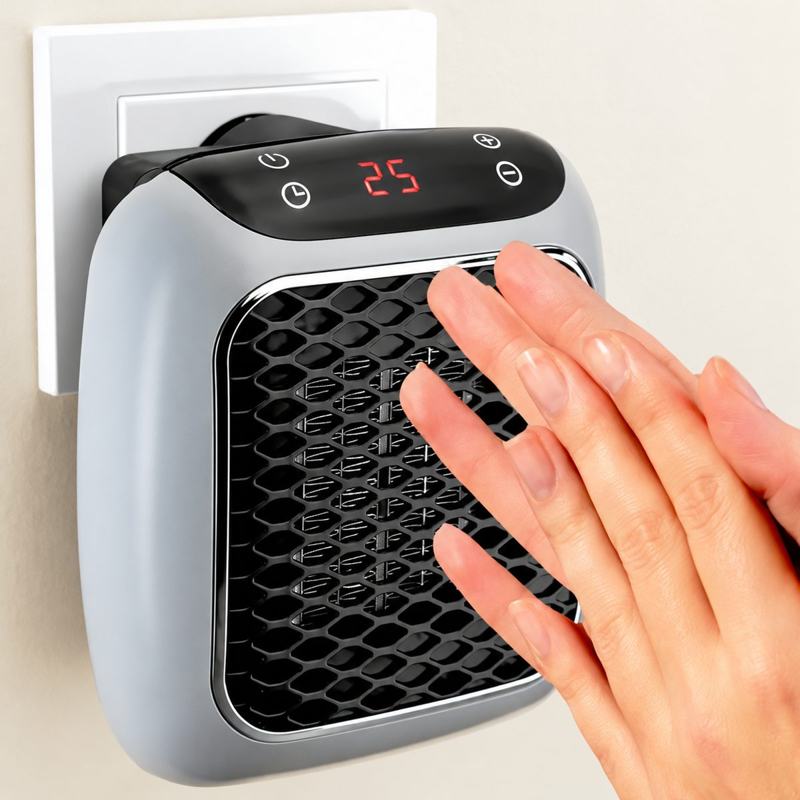
RapidHeat is a plug-in PTC ceramic option with a thermostat, eco mode, timer and overheat protection for small-to-medium rooms. That description is not a numerical coverage guarantee. Check the actual label and manual against your room, outlet and intended use. It may suit supervised supplementary comfort where conditions are appropriate, but it should not be presented as a solution for every room size. Sound sizing combines realistic demand, documented equipment information and a safe place to operate it.
Sources
Frequently asked questions
Is 10 watts per square foot accurate for every home?
No. It is a preliminary rule, not a heat-loss calculation. Climate, windows, insulation, leakage, ceiling height and existing heating can all move the real requirement above or below that estimate.
How do I calculate an L-shaped room?
Divide it into non-overlapping rectangles, multiply length by width for each part and add the areas. Account separately for open connections into other rooms rather than treating them as closed boundaries.
Does a taller ceiling require a bigger heater?
It can increase demand and temperature stratification, but floor area alone cannot quantify the change. Ask for a heat-loss assessment instead of using an automatic multiplier as a final sizing decision.
Can a smaller heater save electricity?
Not necessarily for equal comfort. It may simply heat for longer or fail to reach the target. Savings come from lower demand, suitable setbacks and shorter use, not small dimensions alone.
Can I add two heaters to meet the estimate?
Do not assume your circuits support that load. Have capacity assessed and compare installed heating options. Separate outlets can share a breaker, and extension cords or power bars are not a solution.
Should I size a heater for overnight use?
Portable heaters should be off and unplugged before sleeping. For necessary overnight room warmth, select an appropriate installed heating solution and address building heat loss rather than planning around unattended portable operation.
Related
Choose your bundle
Free shipping
Prices in CAD. Most homes need one per room.
Your order
- 2 RapidHeat heatersCA$119.00
- Tracked shipping across CanadaFREE
- 30-day guaranteeIncluded
TotalCA$119.00
You save CA$200
Ships with tracking. Free across Canada. You won't be charged until you review your order.
- Free Canada shipping
- 30-day returns
- Secure checkout
- 30-day guarantee
- Free shipping in Canada
- Secure checkout